
The history of the Philippines during the Second World War is often recounted through the movements of armies, the strategies of generals, and the tragic falls of Bataan and Corregidor. Yet, running parallel to the military campaigns is a narrative just as vital, though often less documented: the experience of Filipina women during the Japanese occupation from 1941 to 1945.
Their wartime reality was not defined by the glamorous or romanticized narratives often found in fiction. It was defined by grueling endurance, quiet sacrifice, and profound courage.
The Frontlines of the Home
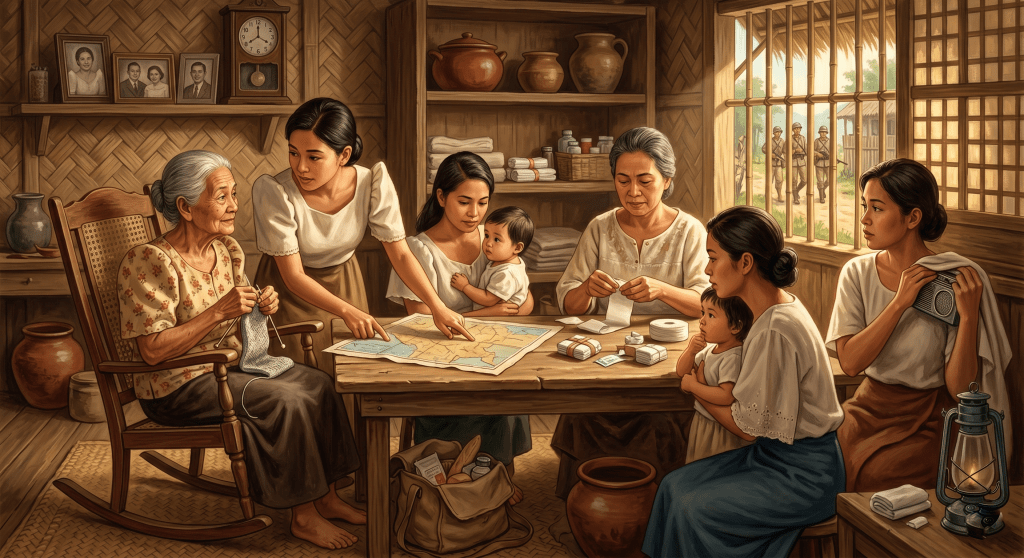
When the Imperial Japanese Army occupied the archipelago, the daily lives of Filipinas changed overnight. With many men conscripted, killed, or fleeing to the mountains to join the guerrilla resistance, women were left to manage the survival of their households under hostile conditions.
- Economic Survival: Hyperinflation caused by the occupation currency (often derisively called “Mickey Mouse money”) made purchasing basic necessities nearly impossible. Women turned to bartering, foraging, and black-market trading to secure rice and medicine for their families.
- The Anchor of Faith: During a time of immense uncertainty and fear, faith became a crucial mechanism for survival. Across various Christian traditions and local communities, churches and neighborhood prayer gatherings served as hubs of mutual support, offering both spiritual solace and a quiet space to share critical information.
The Resistance: Spies, Smugglers, and Soldiers
Filipinas were not merely passive observers of the war; many actively worked to undermine the occupation. They leveraged the fact that occupying forces often underestimated women, using this blind spot to their advantage.
- Josefa Llanes Escoda: A prominent social worker and founder of the Girl Scouts of the Philippines, Escoda and her husband systematically smuggled food, clothing, and vital medicines to Filipino and American prisoners of war enduring the horrors of the Bataan Death March and the concentration camps at Capas. Her network saved countless lives before she was eventually discovered, imprisoned, and executed by Japanese forces in 1945.
- Magdalena Leones: Operating in Northern Luzon, Leones served as a special agent and intelligence officer. She memorized the names of enemy ships, their contents, and the identities of Japanese commanders, relaying this information to guerrilla forces. She personally smuggled radio parts and explosives through heavily guarded checkpoints. For her verifiable, life-saving intelligence work, she became the only Filipina to be awarded the United States Silver Star during WWII.
- Medical Workers: Nurses and civilian doctors routinely risked their lives treating wounded guerrilla fighters in secret, fully aware that aiding the resistance carried a penalty of death.
The Unspoken Trauma: The Malaya Lolas
Any factual recounting of this era must compassionately acknowledge the deep wounds inflicted upon Filipina women.
As the war progressed, the Japanese military systematically institutionalized sexual slavery. An estimated 1,000 Filipina women and girls were abducted, confined in garrison houses, and forced into servitude as “comfort women.”
The trauma endured by these women—who later organized under the name Malaya Lolas (Free Grandmothers)—was both physical and psychological. For decades after the war, a profound cultural stigma forced many to carry their pain in silence. It was only in the 1990s that survivors began stepping forward to publicly demand official apologies and historical recognition. Their struggle for justice has been a long, sobering reminder of the enduring scars of war.
A Legacy of Endurance
The liberation of the Philippines in 1945 brought an end to the occupation, but the rebuilding of the nation rested heavily on the shoulders of its women. They buried the dead, rebuilt broken communities, and worked to heal families fractured by years of violence.
Looking back at the Filipina experience during World War II requires us to strip away sentimentality and face the stark truths of the era. Their legacy is not a neat, comforting story. It is a testament to the raw, unyielding human capacity to endure deep suffering, hold fast to faith and conviction, and do what is necessary to protect the lives of others.
 Tom & Nancy Cook