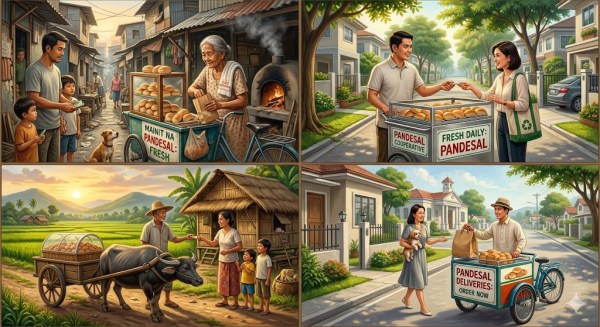
Long before the sun rises over the archipelago, the rhythmic thud of dough hitting wooden tables and the warm, yeasty scent of baking bread signal the start of the Filipino day. At the heart of this morning ritual is pandesal.
More than just a staple food, pandesal is a profound reflection of Philippine history. It is a story of colonization, adaptation, and the daily economic realities of the Filipino working class.
The Spanish Blueprint
The story of pandesal begins in the 16th century with the arrival of the Spanish. Wheat is not native to the tropical climate of the Philippines, but Spanish colonizers, deeply reliant on bread for their own daily diet and religious sacraments, began importing wheat flour.
The original bread baked in the islands was called pan de sal, literally translating to “bread of salt.” However, the earliest iterations of this bread were vastly different from what we know today. Modeled after the French baguette or the Spanish pan de suelo (floor bread, baked directly on the floor of a wood-fired oven), the original pandesal was hard, crusty, and distinctly savory. It was a bread born of colonial necessity, baked with inferior, imported flour that often yielded a dense, tough crust.
The Sweet Transformation
The pandesal we recognize today—soft, sweet, and coated in fine breadcrumbs—is actually a product of the American colonial period in the early 20th century.
When the United States took control of the Philippines, they introduced cheaper, lower-protein American wheat to the market. They also brought commercial baking yeast and the use of baking pans. This fundamentally changed the chemistry of the neighborhood panaderia (bakery).
To mask the slightly sour taste of the commercial yeast and to appeal to the Filipino palate, which inherently favors sweeter profiles, bakers began adding more sugar to the dough. The lower-protein flour resulted in a much softer, fluffier texture. To prevent the dough from sticking to the newly introduced metal baking pans, bakers rolled the portions in fine breadcrumbs before baking.
In a twist of historical irony, pan de sal lost most of its saltiness, yet kept its name.
The Barometer of the Masses
Today, pandesal is the great equalizer, found on the breakfast tables of the wealthy and the indigent alike. But its true significance lies in its role as a lifeline for the working class.
For generations of laborers, farmers, and urban poor, a brown paper bag of hot pandesal paired with a simple cup of instant coffee (or dipped directly into the mug) constitutes an entire, affordable breakfast. It is a source of immediate, cheap energy required for grueling manual labor.
Because it is so deeply tied to the daily survival of the poor, pandesal also serves as an unofficial economic barometer for the nation. When global wheat prices surge, or the cost of sugar and fuel skyrockets, local bakers are faced with an impossible choice: raise the price and alienate their poorest neighbors, or keep the price the same and shrink the dough.
This has led to the phenomenon of “shrinkflation” at the neighborhood level. Over the decades, the standard pandesal has quietly shrunk in size, a physical manifestation of inflation and the relentless economic pressure placed on the working class.
Resilience in a Paper Bag
Despite economic hardships, the neighborhood panaderia remains a vital community hub, and the bread itself remains a symbol of profound adaptability. The Filipino people took a colonial import, softened it, sweetened it, and made it entirely their own. Pandesal is not just the bread of the Philippines; it is the resilient, daily fuel of its people.
 Tom & Nancy Cook