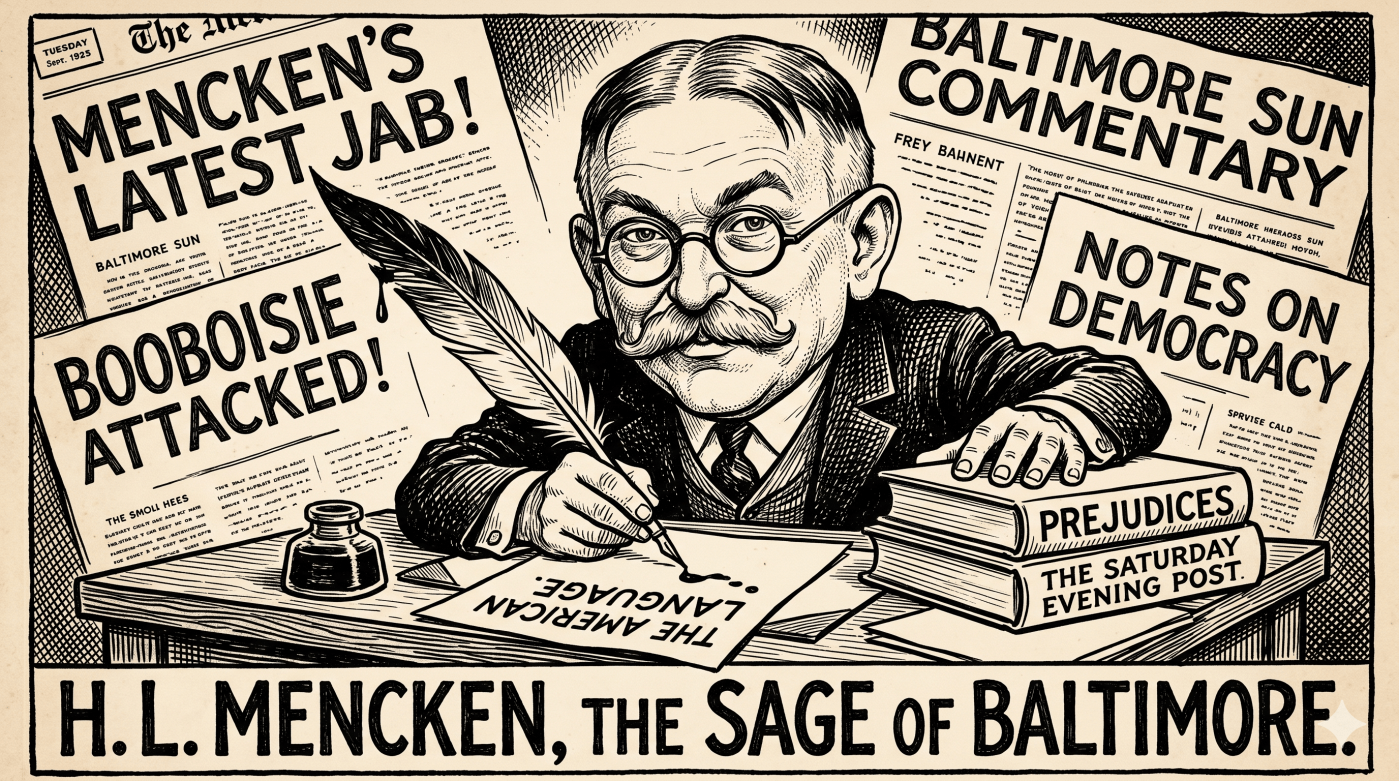
Editor’s Note: What would the sharpest critics of the past make of today’s political theater? To find out, we used artificial intelligence to imagine how historical commentators would review current events. The following is an AI-generated commentary on President Trump’s recent state visit to China, written in the cynical, unmistakable voice of H.L. Mencken.
To the dedicated student of human theater, the expedition of Mr. Trump to the Middle Kingdom offers a spectacle of almost magnificent proportions. One need not subscribe to the partisan hysterics of the daily press to appreciate the sheer, unadulterated pageantry of the affair. Here, after all, was the grand collision of two formidable egos, draped in the ancient silks of diplomacy and broadcast live for the amusement of the global gallery.
The stagecraft, one must admit, was flawless. Mr. Xi, playing the role of the benevolent but unyielding sovereign, arranged what the mandarins in the press billed as a “state visit-plus.” This culminated in a dinner within the walls of the Forbidden City—a real estate concession not granted to a foreign leader since the establishment of the People’s Republic. For a visiting president whose primary genius has always rested in his appreciation for grand facades and gilded framing, it was a masterful stroke of flattery.
The verifiable details of the summit are where the true nature of statecraft reveals itself. Rather than the table-thumping belligerence promised on the campaign trail, the American president assumed the posture of an admiring, almost genial guest. In a maneuver of dynastic diplomacy that would have made the Ming emperors nod in quiet recognition, he produced an iPad to show Mr. Xi a video of his young granddaughter, Arabella, singing dutifully in Mandarin. It was a disarming, highly calculated gesture—a reminder that in the upper stratospheres of power, politics is often managed as a family business.
Then came the inevitable arithmetic.
The grand, triumphant chord of the expedition was the announcement of some $253 billion in trade deals. The public was expected to stand in awe of the sum. Yet, the knowledgeable observer understands it was simply the customary exchange of paper. The vast majority of these agreements were non-binding memorandums of understanding—polite promises to perhaps, eventually, consider doing business. It was a performance designed precisely to pacify the folks back in the heartland, executed with the precision of a seasoned showman closing out the second act.
Perhaps the most revealing moment, however, was Mr. Trump’s address regarding the trade deficit. Standing beside his host, he delivered a rhetorical twist of remarkable audacity. He did not blame China for outmaneuvering American markets; instead, he placed the blame squarely on the shoulders of his own predecessors in Washington for allowing the ledger to bleed. It was a candid, entirely pragmatic admission, delivered with a shrug. It proved that the man understands at least one fundamental truth of the political pageant: when the red carpet is rolled out, it is poor form to insult the host, especially when there are past administrations so conveniently available to take the lash.
In the end, the Beijing expedition altered very little of the underlying geopolitical reality. The economic friction, the naval posturing, the endless jostling for supremacy—all of this remained exactly where it was before Air Force One touched down. But as a piece of performance art, it was unparalleled. The emperors of old would have recognized the transaction instantly: the tribute of flattery exchanged for the illusion of triumph. And the public, as always, received exactly the show it paid for.
 Tom & Nancy Cook
Leave a comment